
Microfiction Tips Collection - Part 1
Originally published on Substack as Notes Sept 2025

Microfiction Writing Tip: 2/9/25
Every word has to count.
In the words of Lin-Manuel Miranda’s “Hamilton”:
“Hit ‘em quick, get out fast!”

Microfiction Writing Tip: 2/9/25
Robert Louis Stevenson wrote “Treasure Island” by starting with the map. With microfiction, you are giving the reader the map, and they are the ones who will fill in the story around it.

Microfiction Writing Tip: 3/09/25
Ask “What if…?” Questions, like Marvel’s classic comics and MCU animated series. As they say in the series “It’s a prism of endless possibilities”.
“What if THIS thing happened? Then, what would happen next as a result? What is the flow-on effect?”
“What if, instead of playing out the way it did, my life went vastly differently?”
“What if, on the day I was to meet my wife, I accidentally slept in and so I never met her? Where would we both be now?”
What if…
Have a go…
Microfiction Writing Tip: 3/09/25
I’m reminded of a scene in “Butch Cassidy and the Sundance Kid” where Robert Redford’s Sundance Kid is having his shooting tested by a potential employer. The employer asks him if he can hit anything with his gun. He says, “Sometimes”. The man throws a small rock a distance away and tells Sundance he wants him to shoot it – he’s not interested in the fancy moves or quick draw – just if Sundance can shoot. Sundance takes a shot and misses. The employer walks off, but as he does, Sundance asks, “Can I move?” He ducks down, shoots twice, and hits the target both times. He tells the employer, “I’m better when I move”.
That’s what we’re doing here with microfiction – You have to move, and move quickly. Get your point across in a flash and then end the piece without any further ado. The reader will be left to pick up the pieces and work it out.

Microfiction Writing Tip: 4/9/25
Saul Zaentz, an American film producer, when he won an Academy Award quoted poet and screenwriter Samuel Hoffenstein, who said, “The Holy Grail is not in the finding, it is in the journey”.
Same thing with microfiction – here, we are not interested in the destination. We’re telling one important scene from the journey. Make it count.

Microfiction Writing Tip: 4/9/25
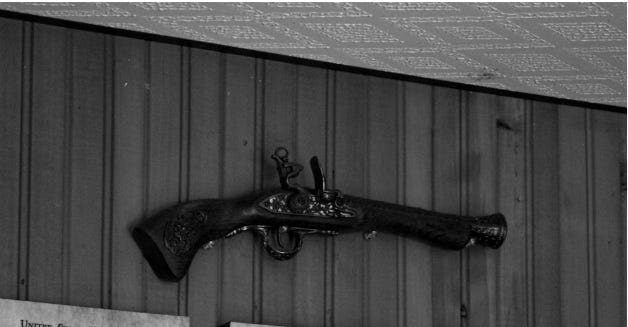
Russian Playwright Anton Chekhov (1860-1904) had a writing principle called “Chekhov’s Gun”, often phrased like this: “Remove everything that has no relevance to the story. If you say in the first chapter that there is a rifle hanging on the wall, in the second or third chapter, it absolutely must go off. If it’s not going to be fired, it shouldn’t be hanging there.“
Only keep what you need to make the story work. If it’s not moving the story forward, get it out of there. Keep the journey free of unnecessary distractions and include only what the reader needs from you.
Microfiction Writing Tip: 4/09/25
In microfiction, even more so than other forms of writing, we must choose what not to say as carefully as we choose what to say…
“A successful book is not made of what is in it, but what is left out of it.” – Mark Twain
https://azevedosreviews.wordpress.com/2013/09/08/mark-twains-20-quotes-on-writing/
Yep. This.
(p.s. I couldn’t corroborate that MT said this, but I don’t care. He was a legend and this is true)

Thanks for reading.
Let me know what you think about any of these. Helpful? Not helpful? Why/why not?
Links to the rest of the collection:
(Also found in the “Writing Tips” Section on the menus at the top of the Microcosm Substack)


#/media/File:What_If...?_(TV_series)_logo.png)